
Reviewed By Tim Lombardo, Senior Director, Food Consulting Services, EAS Consulting Group, a Certified Group company
1-Minute Summary
- Most packaged foods sold in the United States need a Nutrition Facts Panel unless a specific exemption applies.
- Start by confirming whether your product is regulated by FDA or USDA, because that determines which labeling rules apply.
- Serving size must follow FDA’s Reference Amounts Customarily Consumed in 21 CFR 101.12, not a marketing preference.
- Recipe calculations and database tools can support early development, but FDA guidance recommends basing final label values on laboratory analysis.
- A Nutrition Facts Panel is only one part of a compliant food label; claims, ingredients, allergens, and other label elements matter, too.
Start With the Right Question
Small businesses and entrepreneurs often ask us how to create a nutrition facts panel for a new product label. The better first question is whether the product needs one at all.
In most cases, the answer is yes. Most packaged foods sold in the United States must include a Nutrition Facts Panel unless a specific exemption applies. Once that question is answered, the next step is deciding how to generate label values you can support with confidence.
Checklist: Do I Need a Nutrition Facts Panel?
Answer these questions in order before you begin the process of creating a Nutrition Facts Panel for your label.
- Is my product regulated by FDA or USDA? (This determines which labeling rules apply to your product.)
- Do I need a Nutrition Facts Panel for this product? (Most packaged foods do, unless a specific exemption applies.)
- Does any exemption apply right now? (Some small businesses, low-volume products, and certain food types may qualify for an exemption.)
- Will that exemption still apply as I grow? (An exemption can be lost if sales increase, distribution expands, or claims are added.)
- What is the correct serving size for my product? (Serving size must follow FDA category rules, not marketing preference.)
- Am I making claims that need support or substantiation? (Claims such as “low sodium” or “good source of fiber” can trigger extra requirements.)
- Am I relying on estimates, or do I have final data? (Recipe calculations may help early on, but final commercial labels are often better supported by lab testing.)
- Does the rest of my label meet regulatory requirements? (The Nutrition Facts Panel is only one part of a compliant food label. Other requirements may include allergen declaration, type size requirements, and statement of identity.)
Is My Product Regulated by FDA or USDA?
Before you create a label, you need to know which federal agency regulates your product.
In the U.S., most packaged foods are regulated by the FDA. That includes products such as:
- Sauces
- Snacks
- Baked goods
- Candy
- Beverages
- Shelf-stable foods
- Condiments
Some products fall under USDA’s Food Safety and Inspection Service instead, including:
- Meat products
- Poultry products
- Certain processed egg products
For most small food businesses, FDA will be the correct starting point. That matters because the labeling rules depend on the product category and who regulates it.
Do I Need a Nutrition Facts Panel?
Usually, yes.
For most packaged foods, nutrition labeling is required unless an exemption applies. Some small businesses may qualify for an exemption, but exemptions are often narrow and can disappear as the business grows.
A Nutrition Facts Panel may still be required if:
- Your sales increase
- Your product no longer qualifies for a small business exemption
- You make a nutrition claim
- You make a health claim
- You do not meet the filing requirements tied to an exemption
Even when an exemption may apply, many businesses still choose to include a Nutrition Facts Panel because retailers and shoppers expect to see one. It is often easier to plan for the panel now than to redesign the label later.
Are There Exemptions to the Nutrition Facts Panel Requirement?
Sometimes, which FDA provides in its Small Business Nutrition Labeling Exemption Guidance.
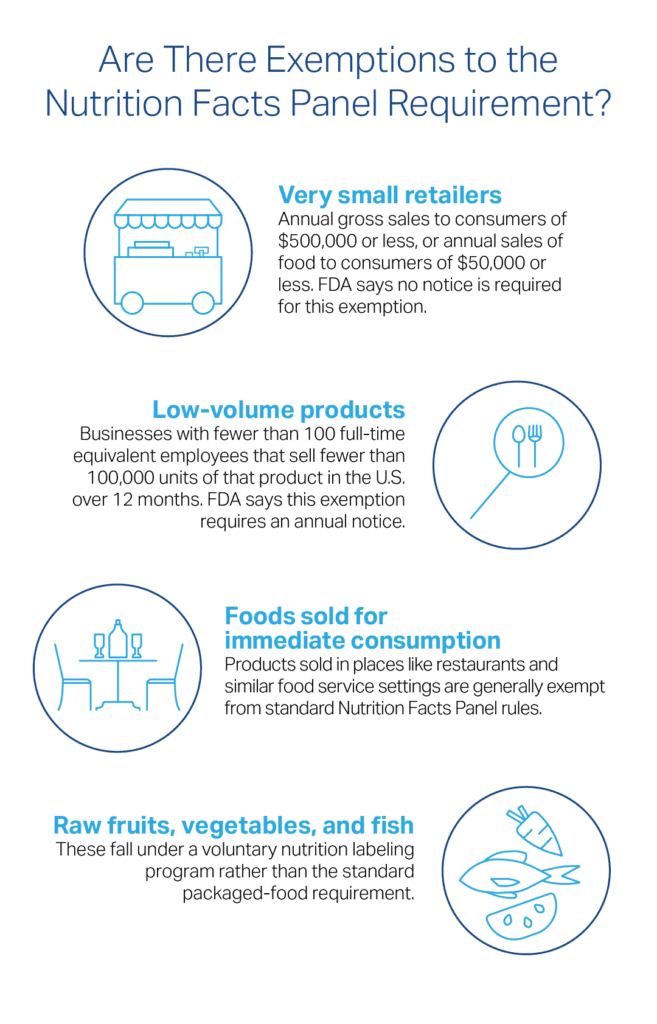
For small food businesses, the most common exemptions are:
- Very small retailers – annual gross sales to consumers of $500,000 or less, or annual sales of food to consumers of $50,000 or less. FDA says no notice is required for this exemption.
- Low-volume products – businesses with fewer than 100 full-time equivalent employees that sell fewer than 100,000 units of that product in the U.S. over 12 months. FDA says this exemption requires an annual notice.
- Foods sold for immediate consumption – products sold in places like restaurants and similar food service settings are generally exempt from standard Nutrition Facts Panel rules.
- Raw fruits, vegetables, and fish – these fall under a voluntary nutrition labeling program rather than the standard packaged-food requirement.
There is one important catch: exemptions are easy to lose. If you make a nutrient content claim, health claim, or provide other nutrition information in labeling or advertising, a small business exemption generally does not apply.
For many packaged food businesses, the safest assumption is still that a Nutrition Facts Panel will be needed.
What Does a Nutrition Facts Panel Include?
For most FDA-regulated foods, the Nutrition Facts Panel must include the core nutrition information required under the Nutrition Labeling and Education Act (NLEA):
- Serving size
- Servings per container
- Calories
- Total fat
- Saturated fat
- Trans fat
- Cholesterol
- Sodium
- Total carbohydrate
- Dietary fiber
- Total sugars
- Added sugars
- Protein
- Vitamin D
- Calcium
- Iron
- Potassium
Not every product will display every nutrient line the same way. If a nutrient is missing or present only in a very small amount, FDA may allow it to be shown as 0, listed as a very small amount, or, in some cases, left off the panel when the rules allow.
For example, a sauce with almost no fat may show Total Fat 0g, while a product with only a trace amount of vitamin D may exclude vitamin D completely if FDA allows it.
For more detail, see the FDA nutrition labeling regulations.
Why Serving Size Matters
A Nutrition Facts Panel is built around the serving size – and it’s not arbitrary.
FDA sets standard serving sizes for food categories using Reference Amounts Customarily Consumed, or RACCs. To find the right serving size for your product, start with 21 CFR 101.12, then use 21 CFR 101.9 for the labeling rules that apply to that serving size.
Serving size affects:
- Calories
- Sodium
- Sugars
- Percent Daily Values
- Whether some claims may be used
For example, FDA lists salsa under dips and similar products, with a reference amount of 2 tablespoons. Snack crackers are generally based on a reference amount of 30 grams. Those standard amounts are the starting point for the serving size shown on the label.
How To Create a Nutrition Facts Panel for My Product?
There are three common ways to create nutrition label values:
- Recipe calculation
- Database analysis
- Nutritional analysis lab testing
Recipe calculations and database analysis can be useful in the early stages because they are often faster and less expensive. But they are still estimates. Once you move into production, the finished product may test differently because of:
- Ingredient variation
- Moisture loss
- Oil uptake
- Cooking changes
- Yield differences
- Processing conditions
FDA does not require every company to use lab testing, and it does not prescribe a single method for determining nutrient values.
In FDA’s nutrition labeling guidance, the agency says the source of the data is the “prerogative of the manufacturer,” but its policy recommends label values be “based on product composition, as determined by laboratory analysis of each nutrient.”
That is why nutritional lab testing from an accredited food testing lab is preferred. It produces greater precision and increased defensibility.
What Should I Send to the Lab?
Send the finished product in the form it will actually be sold.
That means your…
- formula
- manufacturing process
- fill weight
- final package form
…should be as close to final as possible before testing begins.
If you test a bench sample and later change the ingredients or process, the results may no longer reflect the final product. That can lead to retesting, relabeling, and extra cost.
Before sending samples, make sure you have decided:
- Final recipe
- Package size
- Product variants that need testing
- Whether you plan to make claims
- Whether the commercial process is locked
What Should I Ask the Lab to Provide?
Your testing lab should provide:
- The analytical results as a Certificate of Analysis (COA)
- Nutrients needed for the panel
- Analytical test methods used
- Formatted Nutrition Facts Panel for application to your product label
- Added support if nutritional claims are involved
This helps you move from testing to a usable label more efficiently.
Be sure the lab is ISO 17025 accredited and uses validated methods that are appropriate for nutrition analysis. FSNS and Certified Laboratories, both Certified Group companies, check those boxes.
How Claims Can Change the Project
Claims can make nutrition labeling more complicated. Terms such as the following are regulated by FDA and have specific definitions, not just marketing meaning:
- Low sodium
- No added sugar
- Sugar-free
- Good source of fiber
- High in protein
A few simple examples show why this matters:
- Low sodium means 140 mg or less of sodium per reference amount customarily consumed and per labeled serving.
- Sugar-free means less than 0.5 g of sugars per serving and must meet the other conditions in the regulation.
- Good source means 10% to 19% of the Daily Value per serving.
- High or excellent source means 20% or more of the Daily Value per serving.
Some claims also trigger extra requirements. For example, no added sugar is only allowed if no sugars, or ingredients that replace added sugars, are added during processing, and some products also need extra disclaimer wording.
That is why claim strategy should be decided before testing and why it’s important to check the FDA regulations regarding claims and food labeling.
The Nutrition Facts Panel Is Not the Whole Label
While this article focuses on your Nutrition Facts Panel, we should point out that it doesn’t make the whole label necessarily compliant.
Most packaged foods also need:
- Statement of identity
- Net quantity of contents
- Ingredient list
- Allergen labeling when required
- Name and address of the responsible business
This is where small brands can run into trouble. They focus on the nutrition panel, but the full package still has to meet labeling requirements.
That is why an optional label review can be valuable before commercialization. A full label review from organization’s like EAS Consulting Group, the regulatory consulting arm of Certified Group, can help you evaluate whether the full package label meets applicable requirements before you go to print. EAS Consulting Group also conducts regularly scheduled Food and Dietary Supplement Labeling Compliance Seminars.
That type of review can help catch issues with claims, ingredient declarations, allergen statements, and other required label elements before the product enters the market.
What Influences Cost to Create a Nutrition Facts Panel for a Product?
For nutritional analysis lab testing, which is FDA’s recommended method per industry guidance, the cost for a single product with no label claims to support is quite reasonable..
However, costs can increase with:
- Multiple SKUs
- Complex product matrix or many ingredients
- Additional testing needed to support claims
- You request rush turnaround time
A simple product with one SKU will usually cost less than a product line with multiple flavors, added nutrients, or claim-driven testing needs. That is why it is smart to define your final formula, SKU list, and claim strategy before sending samples to the lab.
Contact FSNS for a custom quote for laboratory testing for your Nutrition Facts Panel.
Contact EAS Consulting Group for a review of your food label, including the Nutrition Facts Panel.

Nutrition Facts Panel FAQs
In many cases, yes. Most packaged foods sold in the United States need a Nutrition Facts Panel unless a specific exemption applies. Small business exemptions may be available in some cases, but they can be limited and easy to lose.
You can get a nutrition panel through recipe calculations, database analysis, or nutritional analysis lab testing. For many small businesses, lab testing is the strongest option because it is based on the finished product and provides better support for commercial labeling.
You can often use recipe calculations during product development. They are useful for early planning, but they may not reflect the final product after processing. That is why many businesses use lab testing before printing the final package.
Under the Nutrition Labeling and Education Act (NLEA) framework, the answer depends on the product, the serving size category, and whether you make any claims. For most FDA-regulated foods, the panel must include serving size, servings per container, calories, total fat, saturated fat, trans fat, cholesterol, sodium, total carbohydrate, dietary fiber, total sugars, added sugars, protein, vitamin D, calcium, iron, and potassium. In some cases, a nutrient may be shown as 0, listed as a very small amount, or omitted if FDA allows it based on the amount present and the absence of related claims. That is why the testing scope should be based on the finished product as sold and the exact label strategy you plan to use.
No. The full package also needs other required elements, such as the product identity, net contents, ingredient list, allergen labeling when required, and the responsible firm’s name and address. An optional regulatory label review can help reduce risk before commercialization.