Reviewed by: Steven Rogers, Corporate Quality Manager, Certified Group
1-Minute Summary
- Targeted antioxidant testing helps verify whether concentrations meet specifications across lots and manufacturing sites.
- Certified Group’s validated HPLC-UV method measures nine synthetic antioxidants in one analysis and reports comfortably to 10 ppm.
- Analytical data help your team assess consistency across lots and sites.
- Concentration results can guide an investigation; shelf life studies evaluate product performance over time.
You Have Antioxidant Specifications, Yet Sensory Characteristics Vary Among Lots or Batches
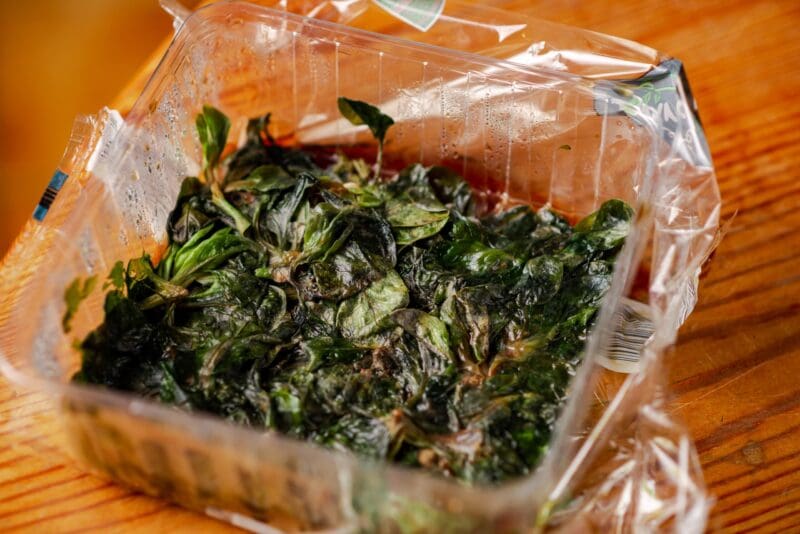
Say that your product has an established formulation and antioxidant specifications. Yet some lots or batches develop off-flavors sooner than others, perhaps at different manufacturing sites. You suspect variation in the antioxidant system, but you need data to assess it.
Antioxidant testing in food provides data to guide that investigation and answer the central question:
Do the measured concentrations meet your specifications, and how do they compare across lots?
Reliable comparisons help your team investigate variation and support the consistent quality consumers expect wherever they buy your product.
This article focuses on our synthetic antioxidant profile. Natural antioxidants also play a role in food formulations, and our laboratory network offers testing for vitamin E, vitamin C, beta-carotene, and lutein.
Let’s look at how our validated HPLC-UV method can help you do that.
How Can Antioxidant Testing Help Verify Consistency Between Lots?
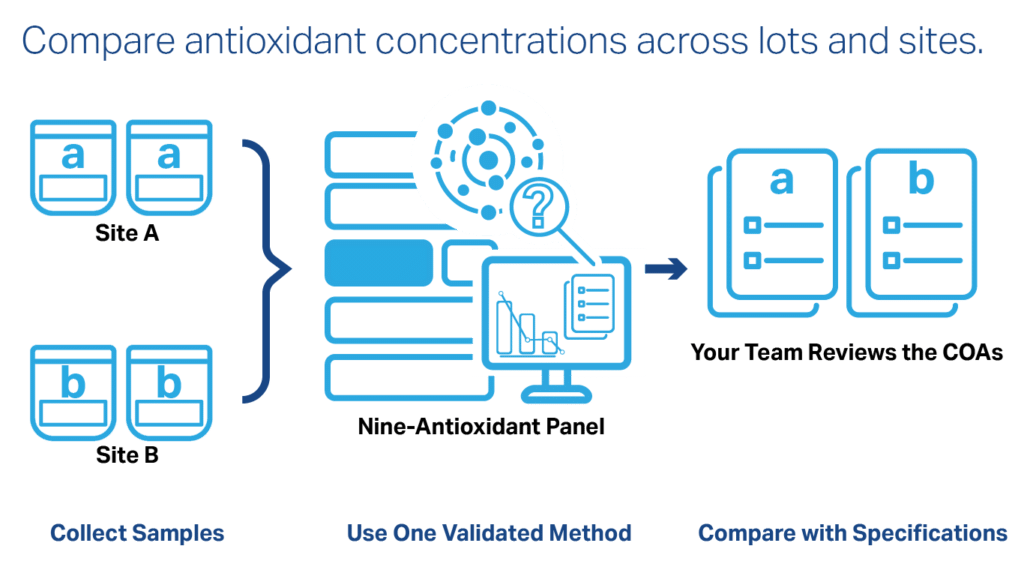
Targeted antioxidant analysis measures specified compounds so you can compare their concentrations with product specifications and results from other lots or batches.
For the product in our example, the immediate goals are to:
- Check whether samples meet the applicable antioxidant specifications.
- Identify concentration differences between comparable lots or sites.
- Decide where additional investigation is warranted.
Concentration differences help your team focus its investigation on potential sources of variation, including manufacturing and storage conditions.
What Makes an Antioxidant Method Fit for Your Product?
A method must measure the relevant compounds reliably in your food matrix at concentrations that matter to your specifications.
Before selecting a panel, ask:
- Does it cover the antioxidants in our specification?
- Is it validated for the intended application?
- Are its reporting level and precision suitable for our decision?
A broad panel is helpful in this case because it can measure a variety of antioxidant compounds in a single run, which increases efficiency when analyzing a complex formulation with many ingredients. We find this to be especially useful for customers formulating shelf-stable products that have multiple compounds in their antioxidant systems.
Which Nine Synthetic Antioxidants Does Certified Group’s Panel Measure?
With this scenario in mind, we expanded our synthetic antioxidant profile from four compounds to nine in a single analysis:
| Compound | Abbreviation |
|---|---|
| Propyl gallate | PG |
| Octyl gallate | OG |
| Lauryl gallate (dodecyl gallate) | LG |
| Nordihydroguaiaretic acid | NDGA |
| 2,6-di-tert-butyl-4-hydroxymethylphenol | IONOX-100 |
| Butylated hydroxyanisole | BHA |
| Butylated hydroxytoluene | BHT |
| Tertiary butylhydroquinone | TBHQ |
| 2,4,5-trihydroxybutyrophenone | THBP |
These antioxidants are often used to help protect fats and oils for oxidizing and producing those off-flavors or off-odors mentioned earlier. For example, propyl gallate is often used in processed meats, while BHT helps preserve color and quality in cereals and potato chips. TBHQ helps delay oil rancidity in products such as microwave popcorn and frozen meals.
How Does One HPLC Analysis Measure Multiple Antioxidants?
To get an idea of how the method works, let’s look at an example chromatogram:

You can see that the first peak is labeled “PG” for Propyl gallate. The second is THBP for 2,4,5-trihydroxybutyrophenone. And so on, with all nine compounds capable of appearing in a single analysis.
We use high-performance liquid chromatography (HPLC) to separate the targeted compounds, while ultraviolet detection and calibration enable their individual measurement.
The method measures nine compounds in a 15-minute instrument run.
What Do the Method’s Validation Results Show?
Validation demonstrated the method’s ability to measure the target antioxidants in food matrices, with average recoveries of 94–105% and relative standard deviations below 10%.
During validation, we analyzed shrimp, paprika, and soy sauce as representative examples of the range of food sample types covered by the method.
| Measure | Result | What it tells you |
| Average recovery | 94–105% | Recovery under validation conditions |
| Relative standard deviation | 4.31–8.87% | Precision of the analytical measurements |
| Reporting level | Comfortably to 10 ppm | Practical reporting capability |
Relative standard deviation describes analytical precision, not an allowable difference between production lots.
Recoveries near 100% show that measured amounts closely matched the amounts added during validation, while the RSDs demonstrate consistent repeated measurements. With reporting comfortably to 10 ppm, the method provides quantitative data your team can compare with product specifications.
How Can Antioxidant Results Guide a Site-to-Site Investigation?
Persistent concentration differences between sites, beyond expected analytical variation, can point to a site-specific variable worth investigating.
If one site consistently reports lower concentrations against the same specifications, compare its manufacturing steps with the SOP and other sites’ practices. Check antioxidant addition, mixing, and processing.
If concentrations are comparable but sensory quality differs, investigate storage and handling differences, including exposure to air, light, or heat. These may affect product performance despite compliant antioxidant concentrations.
These trends help your team prioritize follow-up checks and evaluate potential causes alongside production and storage records.
How Does Shelf-Life Testing Complement Antioxidant Analysis?
Antioxidant analysis verifies concentrations against specifications, while shelf life testing evaluates how long the finished product maintains acceptable quality.
For that, it’s best to conduct a shelf life study to evaluate product performance over time. Doing so provides the clearest picture of how the antioxidant system performs during real-world conditions. This allows you to set a defensible and appropriate date code on the label to ensure the longest shelf life while maintaining acceptable sensory characteristics.
Certified Group’s Lab+ team can help design and conduct studies that complement compositional testing and support your overall product strategy.
Ready to Check Antioxidant Consistency in Your Food Products?
Our validated nine-compound HPLC-UV panel helps your team assess synthetic antioxidant consistency across lots and sites. As mentioned, we can also analyze natural antioxidants (vitamin E, vitamin C, beta-carotene, and lutein). We provide a certificate of analysis (COA), which your team compares with its own specifications. Contact us about antioxidants testing in food samples for your company.
Check out our webinar on antioxidants lab testing here, which explains how rancidity occurs, regulatory guidelines for synthetic antioxidants, and more.