
 Aaron Pleitner
Aaron Pleitner
Aaron Pleitner
1-Minute Summary
- Define microbiological, chemical, and sensory end-of-life criteria before testing.
- Use shelf life studies to track spoilage, quality changes, and sensory acceptability.
- Identify the earliest data point where any critical limit fails.
- Apply a conservative margin, round to a practical date, and document.
How to Calculate Shelf Life of Food Using End-of-life Criteria
Food scientists must know how to calculate shelf life of food so companies can set an optimal best-by or expiration date. In essence, you’re asking…
| “At what point is this product no longer safe, high-quality, and acceptable to my customer?”
Food shelf life testing provides microbiological counts, analytical data, and sensory scores over time. To determine the shelf life of food products in a defensible way, you need clear end-of-life criteria and a structured way to interpret that data.
This article explains how food scientists:
- Define end-of-life criteria before testing.
- Use microbiological data to designate spoilage.
- Use chemical and physical data to track quality loss.
- Use sensory panels to reflect real customer experience.
- Combine all three to calculate a realistic, defensible shelf life date.
How to Determine the Shelf Life of Food Products – Process Diagram
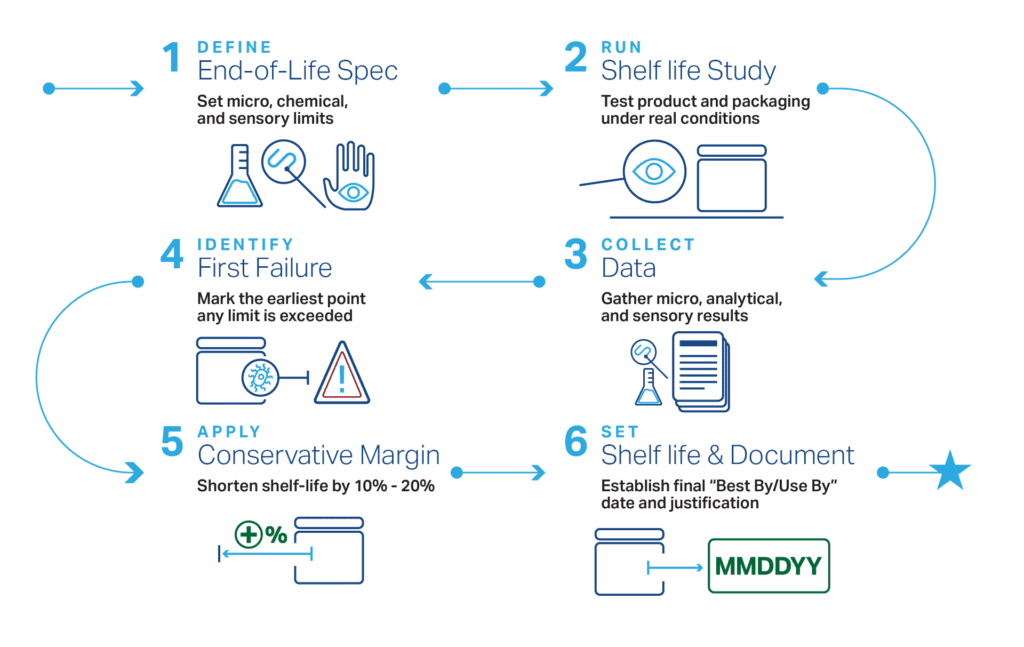
1. Define End-of-life Criteria Before You Calculate Food Shelf Life
The first step in how to determine the shelf life of food products is to establish clear criteria for when the product is no longer acceptable.
Create a simple “end-of-life specification” that answers three questions:
- Microbiological: When are total counts and spoilage organisms too high for this product?
- Chemical/physical: When do rancidity, moisture, pH, or nutrient levels move out of range?
- Sensory: When would a customer say, “The product quality no longer meets what I expected the day of purchase.”
Include:
- Micro limits – maximum acceptable aerobic plate count, yeast and mold, and specific spoilage organisms (e.g., lactic acid bacteria in chilled products).
- Chemical/physical limits – maximum rancidity markers, acceptable moisture and water activity ranges, acceptable pH range, minimum % of label claim for key nutrients or actives.
- Sensory limits – clear descriptions of unacceptable appearance, odor, flavor, and texture.
If you want to calculate shelf life of food in a way you can defend to customers, auditors, and regulators, this document is your starting point.
If you’re thinking, “I have no idea where to start”, don’t be concerned – our food shelf life testing team can provide guidance.
2. Microbiological Data (When Spoilage Says, “Time’s Up”)
In a standard food shelf life study, you track naturally occurring microflora and overall hygiene – you are not using pathogens as normal end points.
At each time point, you typically measure:
- Total aerobic plate count (APC)
- Yeast and mold counts
- Sometimes lactic acid bacteria or other known spoilers
When you determine the shelf life of a food product based on micro data, you look at both:
- Absolute values – when counts enter your predefined “too high” region.
- Trends – rate of change from starting populations; stable counts followed by a sharp rise near the end of storage strongly suggest shelf life is being exhausted.
For some categories, specific spoilage organisms can be more sensitive than generic counts:
- Lactic acid bacteria causing gas or sour off-notes in chilled foods.
- Heat-resistant spoilage organisms driving off-odors in thermally processed beverages.
When these reach your limits or clearly cause visible or sensory spoilage, you have reached microbiological end-of-life.
3. Chemical and Physical Changes (Measurable Changes in Quality)
To calculate the shelf life of food, you also need to watch how the product’s chemistry and physical attributes change over time.
Common analytical end-of-life drivers:
- Oxidative rancidity – High-fat foods (chips, nuts, granola, oil-based snacks) often reach end of shelf life when rancidity markers (peroxide value, anisidine value, TBA) cross your internal thresholds, resulting in the sensory panel detecting off-flavors.
- pH drift – pH decrease in meats and ready-to-eat meals can indicate spoilage metabolism; pH drop in fermented foods can push flavor and texture outside your target range and indicate continued fermentation after product release.
- Moisture and water activity (aw) changes – Moisture loss or gain can cause staling, caking, sogginess, or loss of crispness. Water activity shifts can move the product into a higher or lower microbiological risk category as an intrinsic product factor.
- Nutrient or active degradation – fortified foods and beverages may reach end-of-life when key nutrients or actives fall below an internal target percentage of label claim.
Working rule: Chemical/physical end-of-life is the first time a critical parameter crosses its limit or clearly will cross before reaching the intended shelf life date.

4. Sensory Results: The Customer’s Perspective on Shelf Life
Customers may not directly relate to lab data, but they certainly care about how your product looks, smells, and tastes. When you want to know how to determine the shelf life of food products in terms of protecting brand reputation, sensory data is critical.
Panels typically evaluate:
- Appearance: color changes, surface drying, separation, visible mold, package bloating.
- Odor: rancid, sour, sulfurous, or “stale” notes.
- Flavor: loss of character (i.e. bland), development of off-notes, (acidity, bitterness, cardboard).
- Texture: staling, sogginess, toughness, loss of crunch or creaminess.
Define in advance:
- The scoring system (e.g., 0–9 for overall acceptability).
- The cut-off for end-of-life (e.g., “end when more than half the panel scores below X on overall acceptability”; “end when the median score is below X on a borderline score designation”).
From a practical standpoint, sensory end-of-life often drives your final decision, because it reflects when a typical consumer would reasonably reject the product or no longer find it acceptable, even if microbiological and analytical values are technically still within limits.
And if they have a bad experience with your product, you have lost a repeat purchase.
End-of-Life Criteria for Food Products

5. How to Calculate Shelf Life of Food From Your Data
Once the shelf life study is complete, you can calculate shelf life of food in a structured way by integrating all three data streams.
Put All Key Data on a Timeline
- Micro counts (APC, yeast/mold, key spoilers).
- Chemical/physical parameters (e.g., PV, moisture, aw, pH, key nutrients).
- Sensory overall-acceptability scores.
Mark the First Failure in Each Category
- First time a microbiological limit is exceeded or obvious microbial spoilage appears.
- First time a chemical or physical parameter moves out of range.
- First time the sensory panel deems the product unacceptable.
- Verify the first-time failure with the proceeding time-point failure.
Define the Technical End-of-Life
- Take the earliest of those failure points as the technical end of shelf life.
- This is your data-driven answer to how to determine the shelf life of a food product in strictly technical terms.
Apply a Conservative Margin and Round
- Reduce that technical time by a reasonable margin (commonly 10–25%) to cover lot-to-lot variation and real-world handling.
- This may also be the previous passing time point.
- Round to a practical shelf-life code (e.g., 75 or 90 days instead of, say, 83 days).
The result is a clear, documented path from test data to a label date. And the same logic applies whether you rely solely on real-time data or use accelerated shelf life testing (for non-microbiological metrics) as a supplementary tool that you later confirm with real-time results.
6. Key Takeaways When Calculating Food Shelf Life
If you want to know how to calculate shelf life of food in a way you can stand behind:
- Define microbiological, analytical, and sensory end-of-life criteria before you start.
- Use food shelf life testing to track naturally occurring spoilage organisms, quality drifts, and real sensory changes.
- Call the technical end-of-life at the earliest point any critical criterion fails.
- Add a conservative margin of 10-25% and round to a practical date that reflects real distribution and variability.
With that structure, your shelf-life date becomes a deliberate, data-driven decision that protects consumers, your brand, and your bottom line – and ensures your food shelf-life testing cost is focused on generating the data that matter most.
Need help designing a food shelf life study? Ready to discuss testing? Contact our food shelf life testing team today and we’ll be happy to help!
