
 Aaron Pleitner
Aaron Pleitner
Aaron Pleitner
1-Minute Summary
- Low water activity prevents bacterial growth in powdered dairy, but it does not prevent pathogen survival.
- Cronobacter sakazakii can persist in dry environments and has been linked to serious illness in infants and product recalls.
- Spore forming bacterial pathogens like Bacillus cereus and Clostridium botulinum survive processing and pose risk after rehydration.
- Proactive environmental monitoring and pathogen testing are essential to protect consumers and prevent costly recalls.
Rethinking Risk in Low‑Moisture Dairy Products
In 2022, contamination of powdered infant formula with Cronobacter sakazakii triggered one of the most disruptive food safety crises in memory. The event led to the shutdown of the processing facility, nationwide recalls, FDA warning letters, import restrictions, congressional scrutiny, and widespread formula shortages. Most tragically, infant illnesses – and reported fatalities – were linked to the outbreak.
Three years later, in 2025, powdered infant formula again made headlines – this time tied to a multistate outbreak involving Clostridium botulinum. This time the whole milk powder ingredient was identified as a potential source of the C. botulinum strain. The investigation prompted recalls, public health warnings, and renewed scrutiny of sanitation and pathogen control in low-moisture dairy facilities.
Two separate incidents. Two different pathogens. One shared vulnerability: powdered dairy.
More than an “Infant Formula” Threat
While infant formula receives the most public attention, powdered dairy ingredients are used across a wide range of products:
- Protein powders
- Meal replacements
- Baked goods
- Confectionery
- Dairy beverages
- Snack foods
- Nutritional supplements
The microbiological risk doesn’t stop at infant formula. Overall: Low moisture does not equal low risk.

The Misconception: “It’s Dry, So It’s Safe”
Powdered dairy products typically have low water activity (aw). This product attribute is critical as all vegetative pathogens require moisture to grow and multiply.
But growth and survival are not the same thing.
Low water activity prevents bacterial proliferation. The restriction of water, however, does not necessarily kill pathogens.
“Moisture” is the “M” in the helpful FAT TOM acronym used to describe the six impactful factors for growth and survival of microorganisms in food.
In fact, certain organisms are remarkably adapted to survive for extended periods – sometimes years – in dry environments. Some form spores. Others enter stress-resistant states. Many persist quietly in a dormant state, present in equipment niches and environmental reservoirs.
This is particularly relevant for Cronobacter sakazakii, a pathogen now synonymous with powdered infant formula contamination.
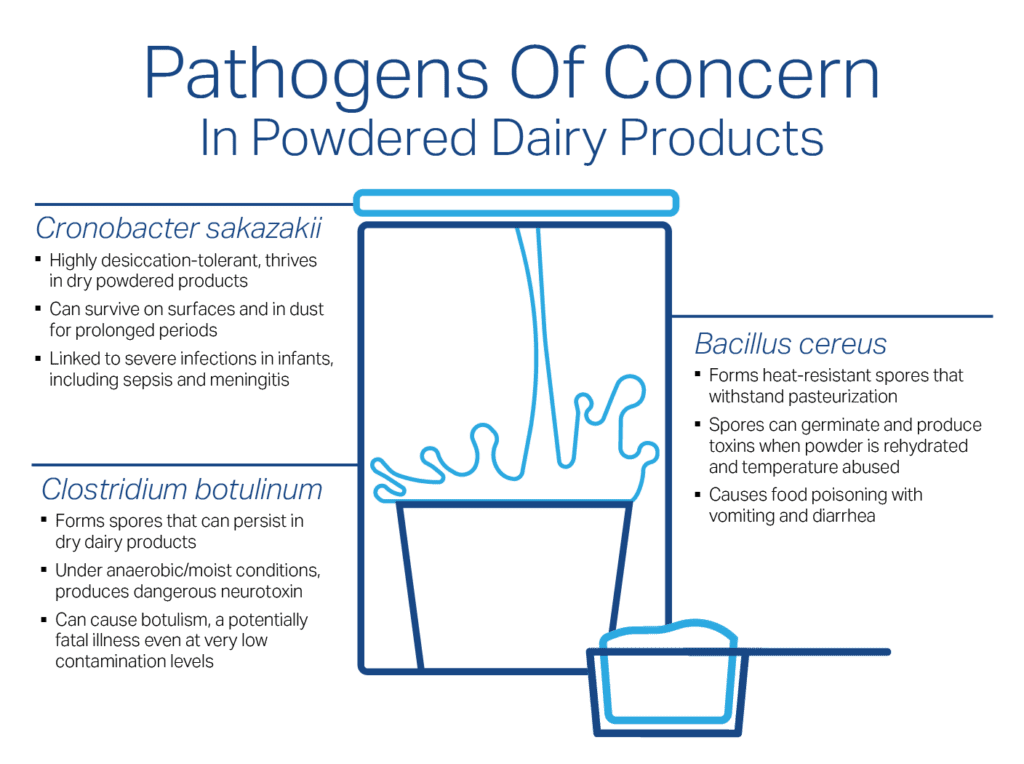
Cronobacter sakazakii Evolved for Dry Environments
Among low-moisture pathogens, Cronobacter sakazakii demands special attention.
This organism has been repeatedly associated with powdered infant formula. In neonates, especially premature or immunocompromised infants, infection can lead to:
- Sepsis
- Meningitis
- Necrotizing enterocolitis
- High mortality rates
What makes Cronobacter particularly concerning is its environmental resilience.
Unlike many pathogens that struggle in dry conditions, Cronobacter sakazakii can survive in powdered products and dry manufacturing environments for prolonged periods. It tolerates desiccation. It can persist in dust. It can harbor in equipment framework, air handling systems, hard-to-clean zones, and facilities that are designed for dry cleaning procedures at a lower frequency
Of note, Salmonella can also survive in low-moisture foods.
Contamination also commonly occurs after the lethality step (like spray drying), such as during blending, transfer, packaging, or environmental exposure.
For facilities producing or handling powdered dairy, this underscores the importance of the following verification programs for interventions and corrective actions:
- Properly designed Environmental Monitoring Program (EMP) for your product.
- Routine pathogen-specific swab testing.
- Aggressive root cause investigations for presumptive positives.
Bacillus cereus – the Spore-Former in Plain Sight
Another organism frequently detected in dairy powders is Bacillus cereus.
Unlike Cronobacter, Bacillus cereus forms spores – dormant structures that withstand heat, drying, and other environmental stresses, including pasteurization and spray drying.
In powdered dairy systems, B. cereus may be present at low levels without causing immediate concern.
The risk emerges when products are rehydrated and temperature-abused.
Under favorable conditions, the B. cereus present as spores can germinate into vegetative cells, multiplying and producing toxins. Some of these toxins are heat-stable, meaning they are not destroyed by subsequent heating.
The takeaway?
A dry powder may appear microbiologically stable at shipment due the product characteristics of low aw but downstream handling introduces new risk. This is particularly relevant for:
- Foodservice reconstitution
- Consumer preparation
- Ingredient incorporation into ready-to-eat foods
Testing programs should include:
- Total aerobic plate counts
- Spore enumeration
- Bacillus cereus monitoring in raw materials
- Strong supplier verification
Clostridium botulinum – Low Probability, High Consequence
While less commonly associated with powdered dairy than Bacillus species, Clostridium botulinum cannot be ignored.
Like Bacillus cereus, it is a spore-forming organism. Under anaerobic, high-moisture conditions, it can produce one of the most potent neurotoxins known.
In dry form, spores can survive quietly. Risk increases when:
- Products are rehydrated
- Anaerobic packaging is used
- Temperature abuse occurs
For infant populations, even low levels of contamination can carry significant consequences.
Preventive strategies include:
- Validation of lethality steps
- Environmental hygiene controls
- Moisture control in processing areas
- Robust spore detection methodologies
- Even limitation of commonly associated food products for infants (e.g. honey)
Environmental Monitoring in Dry Facilities
Unlike wet plants, where water is an obvious risk factor, dry facilities often rely on compressed air, sweeping, or vacuum systems – all of which can aerosolize dust and spread contamination and highlight the need for periodic air sampling in your food manufacturing environment.
Key risk factors include:
- Powder accumulation in overhead structures
- Condensation
- Employee traffic patterns
- Equipment framework and hollow rollers
- Inadequate hygienic zone segregation
An effective Environmental Monitoring Program (EMP) in powdered dairy facilities should include:
- Zone 1–4 swabbing while following environmental swabbing best practices
- Pathogen-specific assays, including Cronobacter sakazakii
- Associated hygiene and pathogen indicators (e.g. Testing for anaerobic spore-forming mesophiles for insight into the potential for Clostridium spp.)
- Trend analysis over time
- Defined corrective action thresholds
- Clear escalation procedures
It is not enough to test occasionally. Data must be trended. Patterns must be recognized. Harborage sites must be eliminated.
How to Build a Proactive Microbiological Testing Program
A strong microbiological safety program needs multiple checks with tactics designed to catch what the others might miss. Here’s how to approach it.
Start with Raw Material Verification
This as your first checkpoint. Even trusted suppliers benefit from regular oversight.
- Review supplier COAs, but don’t rely on them alone.
- Build in periodic verification testing so you know their results align with yours.
- Take time to audit supplier controls, especially around spore-formers and Cronobacter. These organisms are stubborn, and they require disciplined preventive systems.
Strengthen Finished Product Testing
- Perform routine microbiological testing as part of your normal workflow.
- Layer in targeted pathogen testing at increased frequency when something changes: new materials, new equipment, environmental positives, or process deviations.
- Use results to establish trends and refine your risk assessments, not just to “check a box.”
Focus on Environmental Monitoring
Your facility environment often tells the story before your product does.
- Make pathogen swabbing a regular habit – not something triggered only by an event.
- Leverage appropriate indicator testing to be proactive and have foresight into the control of your environment.
- Dig into presumptive positives quickly; they’re windows into your hidden risks.
- Validate that your sanitation is doing what you think it’s doing. “Clean” and “microbiologically safe” are two different things.
Choose the Right Methods
Your testing toolbox matters just as much as the testing plan.
- Use sensitive molecular screening methods to catch issues early.
- Follow up with cultural confirmation to maintain regulatory defensibility.
- Rely only on validated, fit-for-purpose methods designed for your matrices.
Low Moisture Is Not a Safety Guarantee
Low aw helps control growth, but it isn’t a kill step.
Cronobacter sakazakii survives in dry environments. Bacillus cereus and Clostridium botulinum spores can tolerate heat and persist until conditions shift in their favor.
In powdered dairy, pathogens may not grow, yet they can still endure – and for vulnerable populations, that endurance is enough to cause harm.
A strong microbiological testing program with environmental monitoring, spore detection, and targeted pathogen testing remains essential for protecting consumers and your brand.