
Reviewed By Kaci Foote, Accreditation Manager, FSNS Certification & Audit
1-Minute Summary
- FSSC certified sites should review the ISO 22002:2025 PRP updates ahead of the release of FSSC 22000 Version 7.
- The biggest change is structural: ISO 22002-100:2025 now holds the common PRPs, while ISO 22002-1:2025 and ISO 22002-4:2025 hold sector-specific requirements.
- Many requirements were moved, not removed, but some controls are now more explicit for allergen control, zoning, CIP, drainage, migration, set-off, incoming materials, sharps, and rework.
- For Version 6 sites, the value now is preparation: early clause mapping should make Version 7 easier to read and implement once published.
Preparing for FSSC 22000 Version 7 Starts with the New ISO 22002 PRPs
FSSC 22000 Version 7 is expected soon, and the new ISO 22002:2025 PRP documents already show where important changes are taking shape.
FSSC has said Version 7 is being developed in part to incorporate the new ISO 22002-x:2025 series, while Version 6 continues using the current ISO/TS 22002-X documents until the transition begins.
That makes the PRPs worth reviewing now because they reveal the new structure, show which requirements moved, and highlight the controls most likely to affect transition planning.
Let’s look at what’s changed in ISO 22002-1:2025 and ISO 22002-4:2025, which most FSNS Certification & Audit customers will use for their FSSC 22000 certification audit.
The Biggest Change: A Common PRP Backbone
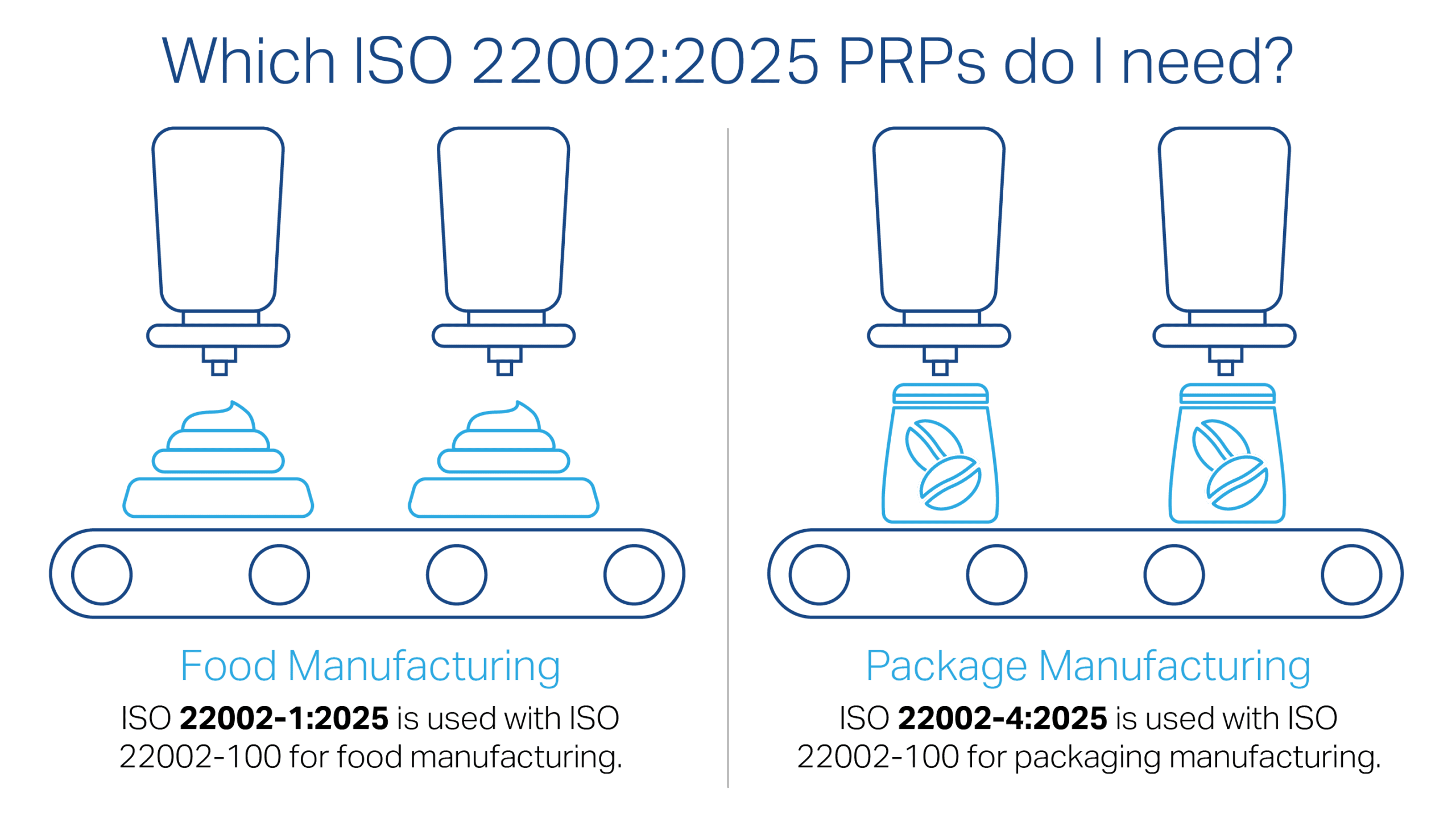
Under the older model, the sector PRP documents were more self-contained. In the 2025 model, ISO split the common requirements into a new shared backbone: ISO 22002-100:2025. The sector documents now add only the requirements specific to those operations.
What This Means
- Read ISO 22002-1:2025 with ISO 22002-100 for food manufacturing.
- Read ISO 22002-4:2025 with ISO 22002-100 for packaging manufacturing.
- Note missing clauses carefully, because some were relocated rather than removed.
What Moved into ISO 22002-100:2025
ISO 22002-100:2025 covers the shared PRP foundation across sectors. Its contents include:
- Buildings and workspace layout
- Utilities
- Pest control
- Waste, FLW management, and recycling
- Equipment suitability and maintenance
- Purchased materials management
- Storage, dispatch, and transport
- Cleaning and disinfection
- Personal hygiene and employee facilities
- Product and consumer information
- Food defense and food fraud
Language Changes to Note
The terminology is more current than in the older standards. Examples include:
- “Cleaning and disinfection” instead of “cleaning and sanitizing”.
- “Waste, FLW management and recycling” instead of “waste disposal”.
- “Food defense and food fraud” instead of “food defense, biovigilance, and bioterrorism”.
What Food Manufacturing Sites Should Focus On
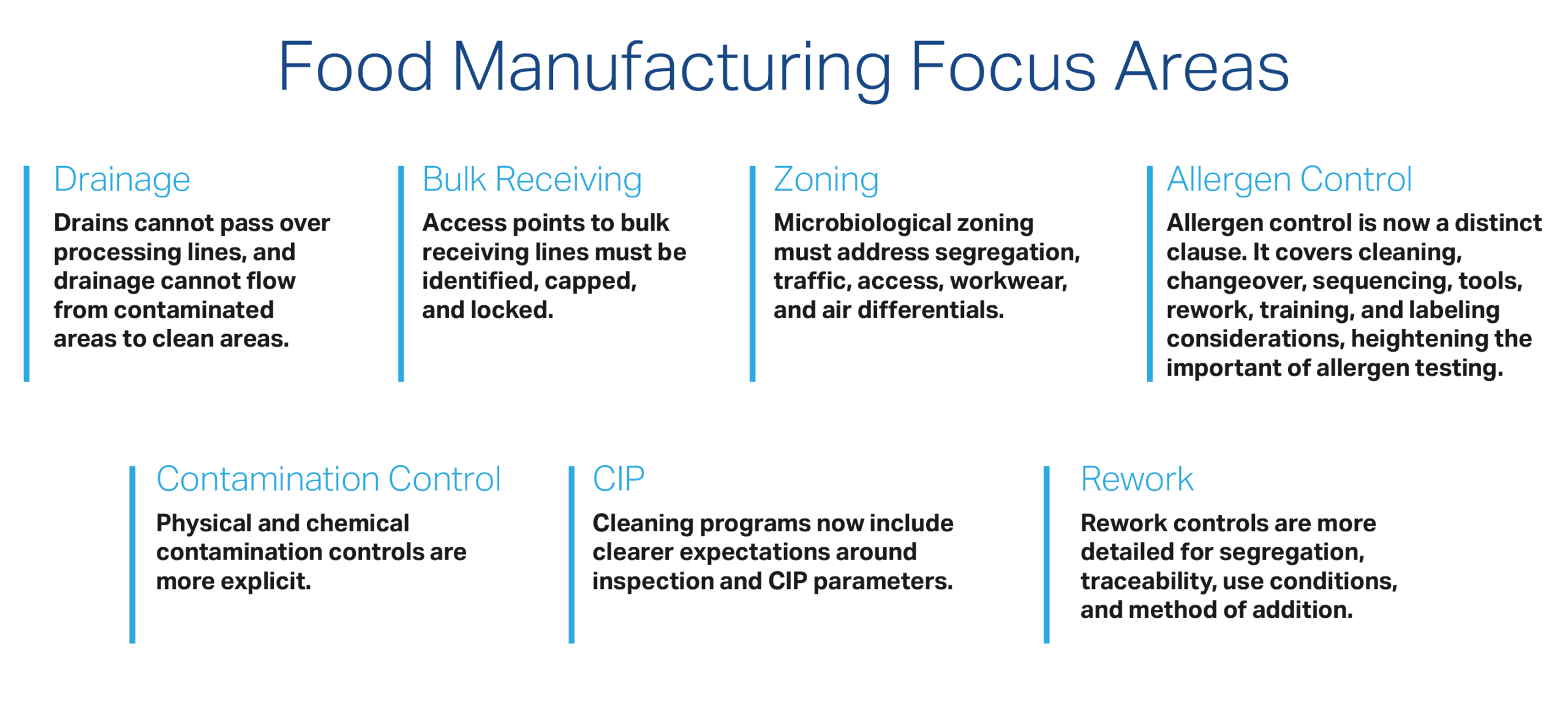
ISO 22002-1:2025 adds the food-manufacturing-specific controls that augment Part 100.
Key Updates
- Drainage: Drains cannot pass over processing lines, and drainage cannot flow from contaminated areas to clean areas.
- Bulk Receiving: Access points to bulk receiving lines must be identified, capped, and locked.
- Zoning: Microbiological zoning must address segregation, traffic, access, workwear, and air differentials.
- Allergen Control: Allergen control is now a distinct clause. It covers cleaning, changeover, sequencing, tools, rework, training, and labeling considerations, heightening the important of allergen testing.
- Contamination Controls: Physical and chemical contamination controls are more explicit.
- CIP: Cleaning programs now include clearer expectations around inspection and CIP parameters.
- Rework: Rework controls are more detailed for segregation, traceability, use conditions, and method of addition.
What Packaging Manufacturing Sites Should Focus On
ISO 22002-4:2025 keeps the packaging-specific requirements and relies on Part 100 for the common PRPs.
Key Updates
- Incoming Materials: The standard adds clearer controls for tamper-evident seals, recycled-source materials, nano materials, plant-based materials, and out-of-spec inputs.
- Set-Off: Set-off is addressed directly for printed and coated materials.
- Migration: Migration is now a distinct clause requiring hazard-based controls.
- Sharps: Sharps and brittle-material controls are more explicit, and snap-off blade knives are prohibited.
- Rework: Rework controls are tied more clearly to regulatory and customer compliance.
What Changed Structurally
Some differences are about document design, not just operational detail.
Food Manufacturing
Compared with ISO/TS 22002-1:2009:
- Shared PRPs moved into Part 100.
- Rework remains in Part 1.
- Product recall procedures no longer appear as a standalone Part 1 clause.
Packaging Manufacturing
Compared with ISO/TS 22002-4:2013:
- Shared PRPs moved into Part 100.
- Food fraud now appears alongside food defense.
- Withdrawal procedures no longer appear as a standalone clause.
- Annex A is no longer present.
How FSSC Version 6 Sites Can Prepare Now
Sites that are certified to FSSC 22000 Version 6 can start practical preparation before Version 7 is released.
- Identify the applicable 2025 PRP document and review it alongside ISO 22002-100:2025.
- Map current procedures to the new PRP structure and identify gaps.
- Update your internal audit tools and training plans.
- Review the final FSSC 22000 Version 7 scheme once published and perform a gap analysis. Then, map out a plan to close gaps before audits against Version 7 begin.
Understand ISO 22002:2025 PRPs Now to Begin Your Site’s Preparation
The ISO 22002:2025 revision does two things at once. It creates a shared PRP backbone in ISO 22002-100 and it sharpens several sector-specific controls for food and packaging manufacturers.
For FSSC 22000 Version 6 sites, that makes now the right time to begin clause mapping and internal review in preparation for your full FSSC 22000 Version 7 gap analysis once the update is released.