
 Aaron Pleitner
Aaron Pleitner
Aaron Pleitner
1-Minute Summary
- Listeria strain typing helps show whether product and environmental isolates are related, supporting faster source tracking and root cause analysis.
- In one case study, a manufacturer of deli meat used strain typing to link the product isolate to the slicer and conveyor, not a utensil positive, which helped them target the harborage site and apply purposeful mitigation efforts.
- In another case study, a manufacturer of ice cream used strain typing to support subtyping without species identification, reducing recall-related concern.
- In both cases, the data helped focus remediation by separating related contamination from unrelated positives, facilitating faster time to regaining hygienic control.
Listeria Strain Typing Can Speed Your Investigation
A facility may find Listeria positives in several areas at once. But that does not necessarily mean every isolate is part of the same contamination event.
Some isolates may be related. Others may be unrelated background findings constituting different strains and species. Until you get answers, how do you know where to direct your remediation?
Why Listeria Strain Typing Matters
This is where Listeria strain typing becomes valuable.
At a high level, Listeria strain typing is a source-tracking tool used to compare isolates and determine whether they are related.
That helps investigators move beyond simple detection and begin answering the questions that matter most.

What Listeria Strain Typing Can Help Reveal
Used correctly, Listeria strain typing can help determine:
- Whether a product isolate is related to environmental isolates.
- Whether repeat positives reflect one resident strain or several unrelated strains.
- Whether a specific piece of equipment may be acting as the source.
- Whether contamination reflects persistent harborage or transient sources and in-plant migration.
Those answers support more targeted corrective action and a faster return to control.
A High-Level Look at the Approach
One approach uses the Bruker IR Biotyper®, which compares microbial isolates based on FT-IR spectra-generated fingerprints.
For Listeria investigations, that comparison can help facilities evaluate relatedness among isolates and direct remediation more efficiently. It can also be leveraged for historical purposes to understand the relatedness of one event to another.
Let’s look at two examples.
Case Study One: Ready-to-Eat Sliced Deli Meat
A ready-to-eat sliced deli meat manufacturer faced a costly contamination event.
Multiple Listeria monocytogenes positives were found in finished product and on food-contact surfaces from the same production line. Product implicated by those positives, and product that had passed over the positive food-contact surfaces, was destroyed.
Production on the line stopped while the facility worked to identify the source.
The key question was whether the isolate found in the product was the same as any of the isolates recovered from the production environment.
What the Analysis Showed
Purified cultures already confirmed as Listeria monocytogenes were prepared and compared.
The analysis revealed…
- Two major clusters (Cluster_21 and Cluster_13 in Figure 1).
- Four isolates (A, B, C, D in the image).
- A = the product isolate.
- B & D = environmental sponge samples from a slicer and attached conveyor.
- C = environmental sponge sample from a utensil.
Listeria strain typing using the Bruker IR Biotyper showed that isolate C was not related to the other three isolates.
Figure 1. Bruker-Generated Dendrogram
How the Facility Responded
Without strain typing, the positive utensil sample could have remained a major suspect, resulting in extended seek-and-destroy efforts and delaying confidence in regaining control.
Instead, the relatedness data pointed to the slicer as the likely source of contamination in the finished sliced deli meat.
The facility took the slicer out of commission, cleaned it thoroughly, and prepared it for return to service. After those actions, there were no further product positives for Listeria monocytogenes.
In this case, Listeria strain typing helped the facility identify the source so they could apply targeted remediation and return to full production in a safe manner.
Case Study Two: Ice Cream Facility Monitoring Listeria-Like Organisms
A second case study involves an ice cream manufacturer conducting routine environmental monitoring for Listeria spp. in its processing environment.
The facility was investigating Listeria-like isolates identified from rapid screening and isolation on selective media agar plates. It wanted to begin subtyping those organisms to determine whether it was dealing with one strain or multiple strains and to better understand contamination patterns over time.
Why the Facility Wanted Subtyping Without Species Identification
Just as importantly, the facility did not want to know which Listeria species were present.
That distinction mattered for regulatory purposes. The facility wanted strain-level insight that could support source tracking and environmental mapping without moving into species identification that could tie the findings more directly to regulatory consequences.
This made strain typing especially useful. It gave the facility a way to compare isolates, study persistence, and track contamination patterns. In doing so, species-identification was not necessary to identify harborage location(s) and apply remediation steps.
What Strain Typing Revealed for the Ice Cream Manufacturer
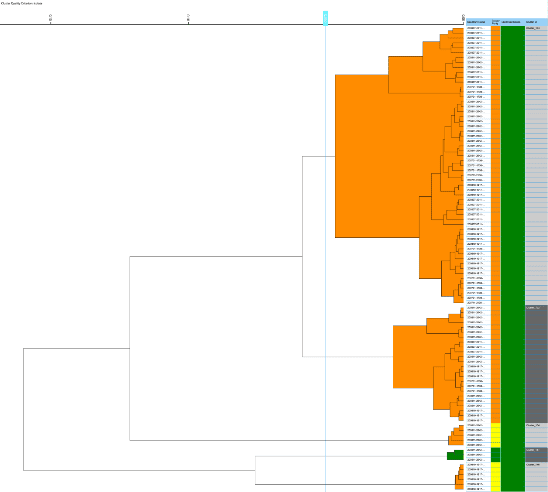
The Listeria-like organisms collected over time were compared and grouped into five distinct clusters.
Those five clusters represented five different strains present in the facility.
Two clusters stood out (the top two orange clusters in Figure 2). The largest contained 19 isolates, and the second largest contained 8 isolates.
Those two larger clusters indicated that the facility had two major resident strains that had established harborage over time.
The remaining clusters were much smaller and suggested transient strains rather than long-term residents.
Figure 2. Bruker-Generated Dendrogram
Turning Results Into Action
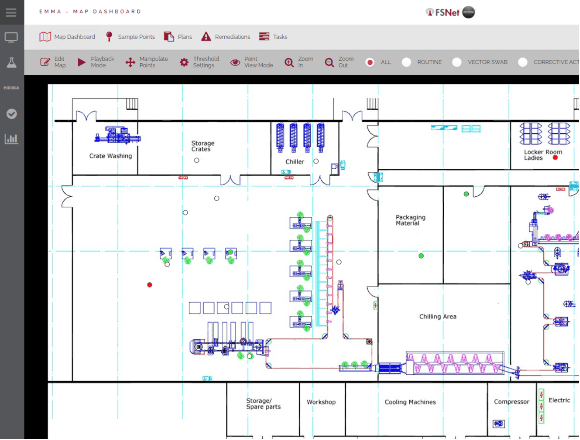
The facility added the strain typing information to the facility maps in its EMP software.
That allowed the team to visualize where each strain was appearing and traveling throughout the plant and to better understand contamination distribution over time.
As more isolates were added, the team could evaluate whether a new positive reflected one of the known resident strains or a newly introduced strain.
Figure 3. Facility Map Showing Listeria-Like Organisms
What These Two Case Studies Show
These two cases highlight different but equally important applications of Listeria strain typing.
In the deli meat case study, strain typing linked product and environmental isolates and helped pinpoint the slicer and attached conveyor as the likely contamination source, thus resulting in traceback and targeted remediation.
In the ice cream case study, strain typing distinguished major resident strains from transient strains and helped the facility understand contamination patterns over time.
In both situations, the same principle applied:
- Determine which isolates are related.
- Remove uncertainty from the investigation.
- Focus remediation where it is most likely to solve the problem.
- Support a faster return to controlled production.
Use Listeria Strain Typing to Support Faster, Smarter Investigations
Listeria strain typing helps facilities move beyond detection and toward real source tracking.
That can make investigations more efficient, remediation more targeted, and food safety programs more effective.
Contact our Lab+ team to learn how to add microbial strain typing to your food safety arsenal.
